Georgian International Media Centre
Archived Post from 2009 & 2011
The Georgian International Media Centre, a centre-right political party in opposition to the government led by Mikheil Saakashvili, offered news about human rights and freedom of expression in Georgia.
Content is from the site's 2009 - 2010 archived pages.
Although it appears the Georgian International Media Centre is no more. The Georgian International Media Centre joined Twitter in 2009 and the last posts were from 2011, likewise the last posts on Facebook were from 2011. The new owners of the domain have chosen to keep the voice of the Georgian International Media Centre visible on the web by posting a small number of archived articles that appeared on this site in 2009 and 2011.
News about human rights and freedom of expression in Georgia.
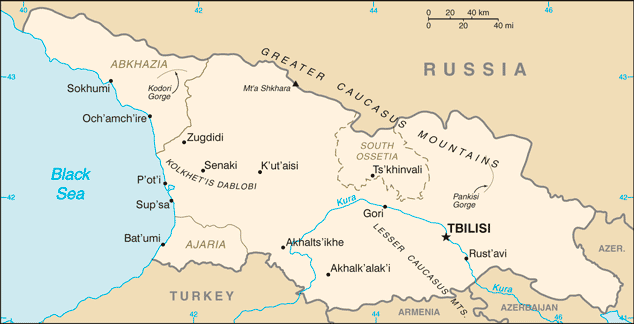
A Bit of History
Wikipedia
Democratic Movement – United Georgia is a centre-right political party in Georgia chaired by Nino Burjanadze; it was founded on 24 November 2008.
On 27 October 2008, in the aftermath of the 2008 South Ossetia war between Russia and Georgia, Burjanadze announced the establishment of "a clear-cut opposition party" called Democratic Movement–United Georgia. Until 2012, the party was in opposition to the government led by Mikheil Saakashvili and his United National Movement. The party favoured closer ties with both Russia and the European Union while maintaining and expanding many of the government's economic and social reform initiatives. It also claimed to seek greater political freedom above and beyond what Saakashvili's administration claimed to provide. It vehemently opposed what it characterised as authoritarianism on the part of Saakashvili's government.
Georgian Opposition Decries Excessive Force By Police After Clash
May 07, 2009 | www.rferl.org/
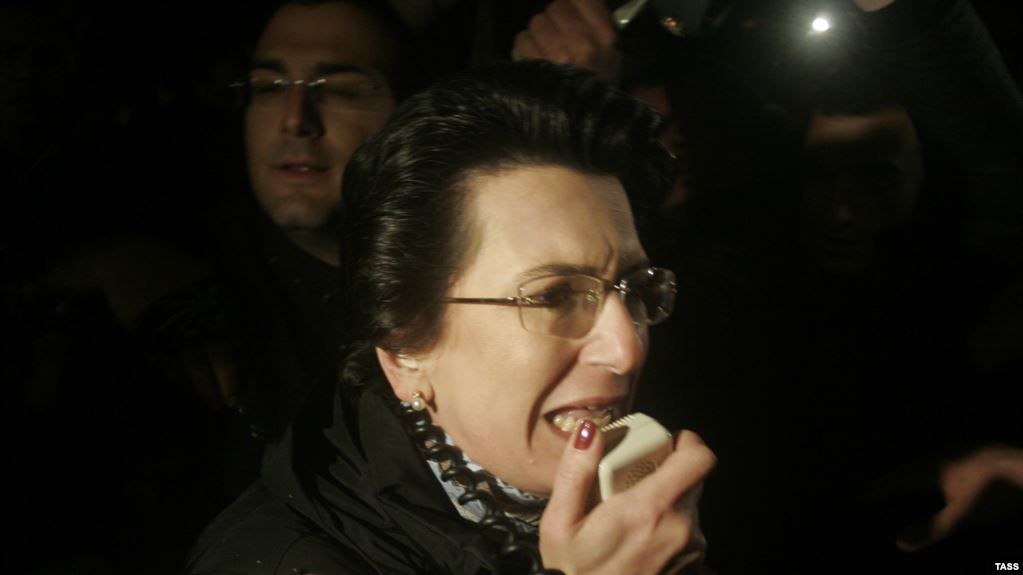
Opposition leader Nino Burjanadze claimed to hold up a rubber bullet fired by the police at demonstrators.
(RFE/RL) -- Georgia's opposition has complained of the authorities using excessive force after a violent clash between opposition activists and riot police in Tbilisi, which has added an extra degree of tension to Georgia's fraught political situation.
Around 30 people, most of them protesters, were injured on May 6, when opposition supporters tried to force their way into one of the capital's main police buildings to retrieve some detained colleagues, who have since been released.
The disturbance in the center of the capital must be reckoned as an embarrassment for President Mikheil Saakashvili. It came the same day as hundreds of soldiers from NATO members were arriving in Georgia to participate in monthlong exercises that will display Western support for Saakashvili in his war of words with Russia.
Another embarrassment came just a day earlier, when some 500 Georgian soldiers at a tank unit based at Mukhrovani declared a mutiny, saying they would no longer take orders. That mutiny ended peacefully, but taken along with the Tbilisi clash increases an impression of a government under considerable pressure.
The opposition had been waging a peaceful campaign demanding the resignation of Saakashvili, whom they blame for worsening the country's political and economic crisis.
'Excessive Force'
But the May 6 protests turned violent, with the opposition claiming that the police used excessive force against the demonstrators, including firing rubber bullets and using truncheons.
Speaking to a rally in Tbilisi on May 7, opposition leader Nino Burjanadze said that demonstrators have "injuries in the area of eyes, forehead, and temple." She said that while the police denied using rubber bullets, she held one in her hand "for the whole world to see."
Deputy Interior Minister Eka Zguladze sought to counter Burjanadze's assertion by saying police had used a minimum of force to control the situation.
Speaking on Georgian television, Zguladze referred to reports that demonstrators had used sticks and stones against police, as they tried to climb a fence into the police compound.
"I want to stress that attacks on police, an attempt to hit police, is a very serious offense and it will not be allowed," Zguladze said.
"Will the police use force? Police will use proportional force, exactly as much force as will be necessary to stop a specific attack," she added. "This will be the minimum possible force, because we are all aware -- at least, [the government is] aware -- how important it is, and I do hope that rally participants understand it, too, though I started having doubts today."
Calls For Dialogue
On May 6, NATO renewed a call for the government and the opposition in Georgia to engage in dialogue, and to pass reforms ensuring freedom of assembly and the media, and for the government to avoid using violence against protesters.
Opposition leader Irakli Alasania, a former Georgian ambassador to the United Nations, took up the same theme in remarks to journalists early on May 7 on the sidelines of the opposition rally in Tbilisi.
"We do need to stop the violence. All political parties, all representatives of the political forces, and the government have to come together at this point and try to solve this problem through the dialogue, through the meeting that may take place in the nearest future," Alasania said in English.
"I really hope that this will be the only way out, a negotiated solution that can be the basis of resolving this political crisis."
Meanwhile, in Washington, U.S. President Barack Obama is set to host Russian Foreign Minister Sergei Lavrov in the Oval Office -- an unusual move, in that an invitation to that room is normally reserved for fellow heads of state and government.
Obama is perceived as trying to stabilize relations with Russia, which is incensed by the present NATO presence in Georgia, which Moscow considers its sphere of influence.
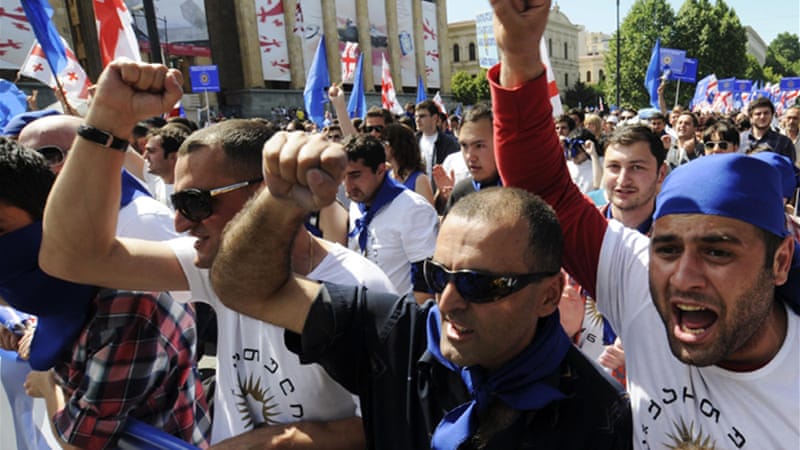
On May 21, 2011 over 10,000 people protested against Mikheil Saakashvili's Government, party leader Nino Burjanadze, her Husband Badri Bitsadze and other leaders of opposition were main figures. Protests overgrew into violence and clash with Police on 26 May 2011 when protesters tried to prevent a parade commemorating Georgian Independence Day, some of leaders were arrested.
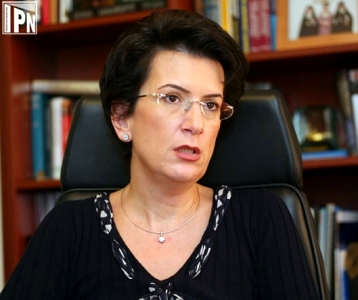
About the Georgian International Media Centre
June 2, 2009 by georgiamedia
This is the website of the Georgian International Media Centre, the global voice of the democratic opposition in Georgia.
The Georgian people are suffering at the hands of the Saakashvili regime: human rights have been abused, free speech stifled, democratic values crushed and the rule of law abandoned. The current government no longer represents the will of the people.
In 2003 Mikhail Saakashvili was one of the leaders of the "Rose Revolution" and promised democracy, integration into Europe and economic progress. Georgia's opposition wants to deliver the democracy the people were promised. We are united in our vision of a democratic, sovereign and prosperous Georgia. Together, we are committed to a new constitutional settlement for Georgia based on:
1. Independent and fair elections
2. Civilian oversight of the police and justice system.
3. Free Media.
4. Transparent Government.
5. A balanced foreign policy and economy, pro NATO and EU membership
You can find out more about the parties and leaders of the Georgian Democratic Opposition.
You can read the joint declaration of the Georgian Democratic Opposition.
With increased repression in Georgia we came together to establish the International Media Centre to ensure that the Saakashvili regime cannot suppress the truth about our homeland.
Georgian opposition politics reflect the vibrancy of the democratic politics that even the current policies of the Saakashvili regime have been unable to suppress. In these pages we profile some of the leading figures and parties of the opposition as well as their international links to the transnational European parties and the global political unions. Although the parties and leaders profiled here have differences of opinion about many issues they have agreed a common programme for the renewal of Georgian democracy
As someone who supported the democratic opposition in Georgia at the time, I remember volunteering to help promote the Georgian International Media Centre website because we believed it was one of the few places where the international community could learn what was actually happening on the ground. The site served as a digital voice for those aligned with the Democratic Movement–United Georgia and other opposition groups who felt that the political climate had become increasingly hostile to dissent.
What impressed me most about the project was its commitment to documenting human-rights concerns, media suppression, and the challenges facing opposition figures during the years when the Saakashvili government dominated the political landscape. The articles and reports published on the site tried to bring attention to protests, clashes with riot police, and the broader struggle for democratic reform that many Georgians believed was necessary after the early optimism of the Rose Revolution began to fade.
Promoting the site was not easy. The political environment was extremely polarized, and opposition activists often faced intimidation. Demonstrations were sometimes met with aggressive riot police tactics, and many of us who supported the movement felt that independent voices were constantly under pressure. The Media Centre tried to provide documentation of those incidents and to explain why so many citizens were demanding accountability and political dialogue.
Another challenge we encountered was online. Even though this was the early era of political digital campaigning, we quickly learned how vulnerable political websites could be. The Georgian International Media Centre attracted organized disinformation campaigns and coordinated online attacks. At one point the site was hit with a wave of toxic backlinks from suspicious domains—something that today would clearly be recognized as a negative-SEO attack. The result was a massive Google penalty that effectively buried the site in search results, making it much harder for international journalists, researchers, and ordinary readers to find our content.
For those of us working behind the scenes, it was frustrating because the goal of the site was simple: to keep information flowing beyond Georgia’s borders. The Media Centre published reports about protests, debates about media freedom, and statements from opposition leaders such as Nino Burjanadze, who led the Democratic Movement–United Georgia after founding it in 2008 in response to what many saw as growing authoritarian tendencies in the government.
Despite the obstacles, I remain proud of having volunteered to promote the site. It was an early example of how political movements tried to use the internet to bypass traditional media channels and communicate directly with the world. Even though the original organization is no longer active and the site now mainly preserves archived material, it remains a fascinating historical snapshot of a turbulent moment in Georgian politics and a reminder of how important independent digital platforms can be during periods of political tension.
Looking back, the Georgian International Media Centre was more than just a website—it was part of a broader effort to keep the conversation about democracy, human rights, and political reform alive in Georgia. For those of us who supported the United Georgia movement and helped amplify its message online, it represented hope that transparency and open debate would ultimately prevail. Thomas Laconich
Welcome to the Georgian International Media Centre

Human rights, property rights and freedom of expression under threat in Georgia under the erratic and increasingly autocratic rule of Mikheil Saakashvili.
~~~~~~~~~~~~~~~~~~~~~~~~~
2010 POSTS
Directors of energy company detained by authorities
May 20, 2010 by georgiamedia
Reports from Georgia today suggest that the Director General and his Deputy of a large investment company have been arrested on charges of tax evasion and financial machinations.
Geno Malazonia and Koba Dimitrishvili who are the two senior officials of JSC Energy Invest have reportedly been detained following a raid by the police and officers of the Ministry of Internal Affairs and Constitutional Security Department. Geno Malazonai had been part of the Georgian regime, working as a deputy head of the Customs Department and as a head of the Anti-Monopolies service.
The company was established in 2004 by Russian and Georgian businesses and is the owner of the Nitrogen factory in Rustavi and the Gardabani Gas turbine power station.
~~~~~~~~~~~~~~~~~~~~~~~~~
European Parliament to debate Georgian aid conditionality
May 19, 2010 by georgiamedia
The European Parliament will debate a draft resolution on the South Caucasus tomorrow (20 May) which calls for improvement to the democratic and media situations in Georgia.
The resolution expresses serious concerns about the lack of media pluralism in the region and calls on the Georgian government "to clarify the situation regarding media ownership and the granting of media licences." It also makes reference to "the initiative of the Georgian Parliament to extend the Public Broadcaster Board to include more opposition and civil society representatives and expects results in this respect."
The report says that "democratisation, good governance, political pluralism, the rule of law, human rights and fundamental freedoms are of paramount importance" and that future EU aid should be conditional on "progress in political dialogue and reform and democratisation processes."
The resolution also welcomes the findings of the Tagliavini Commission, which criticized both Russia and Georgia, and calls for the establishment of a Conference on Security and Cooperation in the South Caucasus with the view of developing a stability agreement in the region.
~~~~~~~~~~~~~~~~~~~~~~~~~
Saakashvili takes advice on media from Iranians
May 19, 2010 by georgiamedia
Eager to please the Islamic Republic ahead of a planned visit by holocaust denier Mahmoud Ahmadinejad, the Georgian Government will today welcome the Deputy Foreign Minister of Iran to discuss issues around media co-operation, and sign a memorandum of understanding.
One can only imagine how the conversation will go. In Iran, television satellites are banned and access to websites are strictly filtered. The only broadcasters allowed are owned and strictly censored by the state, preventing any criticism of the government. A number of opposition newspapers have been shut down by the regime and during the aftermath of the Presidential elections, there was a huge crackdown on access to social networking sites. The regime broadcasts its propaganda internationally via a 24 hour English news channel, Press TV but regularly scrambles the feed from the BBC and CNN to prevent Iranians getting access to outside news coverage.
The Georgians are admittedly more subtle in their approach to censoring the media – shutting down independent TV stations like Imedi under the pretext of a national emergency, and seeking to prevent advertisers from supporting opposition stations while government subsidies are filtered through to regime-supporting broadcasters like Rustavi.
Given President Saakashvili's stated aimed to improve media freedom, one can only imagine what advice he can be getting from the Iranians. Not since Kissinger was awarded the Nobel Peace Prize has real life oupone satire so effortlessly.
~~~~~~~~~~~~~~~~~~~~~~~~~
Saakashvili distances himself yet further from US on Iran nuclear issue
May 18, 2010 by georgiamedia
Mikehil Saakashvili has underlined the growing distance between his government and the United States on the key foreign policy issue of Iran by enthusiastically welcoming a deal struck between Brazil, Turkey and the Islamic republic over nuclear reprocessing.
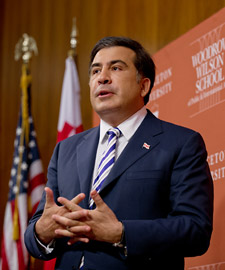
While the United States said that it would continue to work on a UN resolution to increase sanctions on Iran, which remains committed to enriching its own uranium, the Georgian president sounded ecstatic:
"This is a matter of death and life for small countries; this is a matter of survival. It has been a hopeless situation for years. Today Brazilian President - who has conveyed his regards to me and I conveyed mine to him - and [the Turkish] PM Erdogan, who has been stating throughout all these months that there was a chance to negotiate and usually his [optimism] was not shared, arrived in Tehran and actually saved [the deal] on Iranian nuclear program."
"This is a real diplomatic breakthrough and a great diplomatic victory for Iran, Europe, the United States and the world and for the entire region, for Turkey and of course for Georgia... This is peace for Iran and for the entire region and for Georgia as well."
Even accounting for Saakashvili's usual willingness to mis-speak first and consider the consequences later, his words could hardly be in greater contrast than those of the White House, whose statement said:
"While it would be a positive step for Iran to transfer low-enriched uranium off of its soil as it agreed to do last October, Iran said today that it would continue its 20% enrichment, which is a direct violation of UN Security Council resolutions"
Georgia has been edging closer to Iran for several months and only this weekend it was reported that Saakashvili as extended a personal invitation to come to Tbilisi to Iranian president Mahmoud Ahmadinejad - notorious in the west for his denial of the holocaust and what many regard as a fraudulent victory in last year's presidential polls - via the new Iranian ambassador.
~~~~~~~~~~~~~~~~~~~~~~~~~
Media monitoring report suggests national broadcasters "stirring up apathy"
May 17, 2010 by georgiamedia
A long time ago - 1974 - a British cabinet minister was reported as saying his opponents in an election campaign were "going round the country, stirring up apathy."
In fact the word used was "complacency" but the more quotable quote - with its obvious disjunction - was the one that stuck and probably conveyed the same meaning anyway: people were being led to believe their vote was not all that important. It is a sense that carries forward into contemporary Georgia and the 30 May local elections
In 1974 the minister, Willie Whitelaw, was worried that people might see the general election as an opportunity to cast a cost free protest vote: maybe he was right, his party lost. But the last thing the Georgian government wants is for people to see 30 May as a way of casting a protest vote in a less important election. Instead the atmosphere is much more like the old anarchist slogan "whoever you vote for the government always win" and people are being lulled into a sense of thinking that either the result is an inevitable victory for the ruling party so there is little point about getting fired up or that, in any case, politics needs to take a back seat to the more urgent task of Georgia's economic development.
For evidence of the stirring up apathy one simply needs to look at the latest media monitoring report on the elections: despite the winner of the mayoral election being generally seen as the front runner to succeed Mikheil Saakashvili as the chief executive of the Georgian state, Rustavi 2, the country's most popular broadcaster and responsible for over ten hours of news broadcasting every week devoted just 28 minutes to the subject between 6 - 12 May.
More positively, the report suggests that opposition candidates, Irakli Alasania in particular, are generally getting a fair crack of the whip in what little coverage there is - though with incumbent Gigi Ugulava well ahead thanks to a skilful propaganda campaign over the previous year (not forgetting the faked Imedi bulletin of 13 March), and a vast one-off boost in public spending in the capital, the regime - and no one doubts they control and pay for all three national stations - can take the gamble on small amounts of balanced coverage for the final few weeks when all the international observers are in town.
~~~~~~~~~~~~~~~~~~~~~~~~~
Gulashvili denies he will seek political asylum
May 17, 2010 by georgiamedia
Malkhaz Gulashvili, media magnate and founder of the "People's Orthodox Movement" - who fled to Tskhinvali after his TV aoppearence on Kavkasia ten days ago to discuss the controversial book "Saidumlo Siroba" degenerated into a punch-up - has told the Georgian Times - part of his media group - that he will return to Tbilisi and is not seeking political asylum either in Russia or through Russian proxies in South Ossetia.
Gulashvili's movement has been attacked as "fascist" and "neo-Nazi" both for its views and because members have been photographed in uniforms with armbands and giving raised arm salutes. Supporters of the movement's activities - such as protests outside Tbilisi State University - who may nort be members - have posted messages on social network Facebook calling for the spilling of "gay blood" (Saidumlo Siroba - the name, a pun on the Georgian term for Last Supper, can be translated as "Holy Crap" - is said to promote homosexuality) and for "Nazi vigour".
Gulashvili denies the charges:
Look for yourself at what fascism is and what our programme is and you will not find anything like fascism in our programme. The two-headed eagle is a Byzantine symbol, not a fascist one. Some poor historians who are out to please the Government, like Simon Maskharashvili, say that this symbol belongs to the Russian Empire. I would like to tell him that it is a Georgian symbol, used for this purpose before it became Byzantium's symbol. It embodies the relationship between the Church and State under a temporal government.
He says the fight at Kavkasia (see video) was a provocation of the Liberty Institute:
The guests on the show studio did not start the fight. Third parties came there and started it. The Liberty Institute planned and carried out the provocation. They could not bear to leave the station with their tails between their legs. I assure you that they will eventually leave Georgia in the same way. I already understood that this organisation controls the Government of Georgia, but before this incident I had hoped that there were still some normal and true people among them, who would have a bitter reaction to the Institute's abuse of the Mother of God. However it now seems that everyone there has been poisoned with the same ideology.
The innocent boys arrested during this incident are knights martyred for Christ. It is not important what Giga Boketi and Levan Ramishvili think about me, the main thing is for God not to be angry with me.
~~~~~~~~~~~~~~~~~~~~~~~~~
Georgia turns south as western relations disappoint
May 17, 2010 by georgiamedia
Turkey's Prime Minister Recep Tayyip Erdoğan is in Batumi today: just the latest of a series of cross border visits by Turkish and Georgian high officials to each other's countries.
Georgia's president and ministers till make the claim that they want the country to integrate with "Euro Atlantic" structures - joining NATO and the European Union, but an increasingly sour tone is also being heard, about the EU in particular, but even the US.
In contrast, the country seems to be drawing ever closer to countries to the south, particularly the two "regional super powers" of Turkey and Iran but also the Arab kingdoms of the Gulf. This only threatens to accelerate Georgia's estrangement from the west: the Obama administration is courting Russia in an effort to isolate Iran, the very opposite direction to the path being taken by the Georgian authorities.
Georgia's motivations to look south are varied. Some are political: Iran opposed Russia over the August war, few of these states are likely to raise difficult questions about human rights or democracy. Some are tactical: Turkey's strengthened regional role (seen again today in negotiations with Iran) makes them important for any actor in the vicinity. Others are economic: Georgia's pipeline hopes need Iran's gas to be viable, Georgia's banks need Arab money if te financial sector is to be regionally important, Batumi looks to Ankara and Turkey's rapid economic growth to fund investment in tourism.
~~~~~~~~~~~~~~~~~~~~~~~~~
2009 POSTS
Sandro Girgvliani case to be heard in Strasbourg on 1 December
October 17, 2009 by georgiamedia
The European Court of Human Rights is to hold a hearing on the case of the murder of Sandro Girgvliani (pictured) on 1 December, a move that promises severe embarrassment for the Georgian regime, which has been accused of complicity in the killing at the highest level.
In the court's own words it is only "exceptional" cases that result in the holding of public hearings - out of the 30,000 or so cases that are referred to the court every year typically less than 40 result in public hearings.
Sandro, a 28-year-old banker, was killed in January 2006 after an argument in a bar which also contained the head of the constitutional security department - the successor of the KGB - Data Akhalaia and Tako Salakaia, wife of the interior minister Vano Merabishvili. The men eventually convicted of his killing - all senior employees of the interior ministry - were released, under Mikheil Saakashvili's pardon, after a little more than three years in jail in September this year.
~~~~~~~~~~~~~~~~~~~~~~~~~
Patriarch criticises Mikheil Saakashvili
October 17, 2008 by georgiamedia
The Catholicos-Patriarch of the Georgian Orthodox Church, Ilia II (pctured), has criticised Georgia's president Mikheil Saakashvili over the latter's decision to shell Tskhinvali in August 2008 - the event that led to the Russian - Georgian war.
Speaking to teachers yesterday (16 October) the Patriarch, generally regarded with high esteem across Georgian society, said that the war had been avoidable. Film of his words were later broadcast by opposition supporting cable TV channel Maestro.
He added, reports RFE-RL: "it will never do to bump your head against the wall without being able to find a door in it; the captain of a ship must lead his vessel, being able to maneuver and escape reefs."
Earlier the same day the president again repeated his claim he had "no choice" but to shell the town in South Ossetia. Speaking on CNN he refused to accept the conclusion of the Tagliavini Commission that the act, by involving indiscriminate attacks on civilians, was against international law.
The patriarch's words mark a furthing widening of the rupture between the administration and the church. In September the patriarchate issued a public rebuke to the national broadcasters, all under government direction, for a series of stories that either attacked the patriarch or offered him up as a cover for controversial government decisions - such as the release of the killers of Sandro Girgviliani.
Government room for manoeuvre against the church is generally thought to be limited: one of the reasons for its respected position in Georgian society is that it resisted even the Bolsheviks, who were eventually forced to recognise its independence from the Russian church.
~~~~~~~~~~~~~~~~~~~~~~~~~
Saakashvili cannot tolerate opposition
July 15, 2009 by georgiamedia
The latest wave of sustained protests against the Georgian government began on April 9 2009, the 20th anniversary of the Soviet army's attack on peaceful demonstrators for independence. Since then protestors have reported widespread physical attacks that are clearly connected with participation in the protests.A report by the Conservative Party of Georgia records 131 such attacks between April and Mid-June.
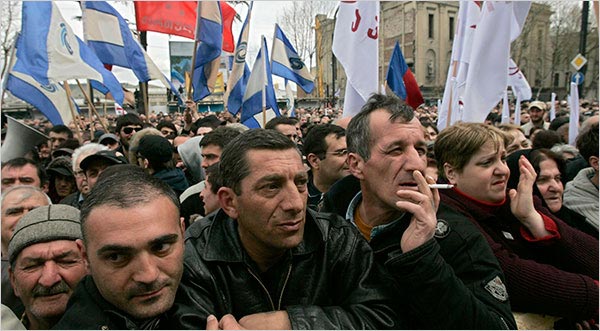
Protesters have been shot with plastic pellets and rubber bullets - even though their use was illegal.
On the morning of May 5, three young protestors were arrested for an altercation with a journalist despite the journalist saying he did not suffer any injury in the incident and not filing charges. The three were taken to police headquarters and say they were then beaten by masked individuals. They were threatened with sexual assault if they did not co-operate. Those protesting outside the police station were shot at.
Levan Gachiceldadze stated:
On the morning of May 5 three young protestors were involved in an altercation with a journalist at the site of demonstrations outside the public broadcasting station in Tbilisi. In a later public statement the journalist said he did not suffer any injury in the incident and did not file any charges against the protestors. Nonetheless, the three youths were arrested. According to the report they made to lawyers allowed to visit them in jail, the three were taken to police headquarters where they were beaten by masked individuals. They also reported being threatened with sexual assault if they did not cooperate.
Details of what had happened to the youths were made known by their lawyers on May 6. In response to this report my brother, Giorgi Gachechiladze, famous for the daily “Cell No. 5” program on a local Tbilisi TV channel, led a march to the police headquarters. There he read the report of torture and assault on the three youths and demanded their immediate release. The march to the police station and Giorgi’s report and demands were broadcast live in Tbilisi by journalists accompanying the marchers.
Failing to receive any response to his demands from the police, Giorgi jumped the fence surrounding the police station and entered the yard within, where he was immediately surrounded and beaten by the Special Forces gathered there. Simultaneously, the Special Forces opened fire on the crowd with plastic pellets and rubber bullets through the fence. I was among the first hit – in the head, arm and shoulder. The sight of blood caused by the shooting enraged the marchers who refused to disperse. The firing went on from the yard and from the station house for an extended period. By the end of the incident more than 40 in the crowd had suffered injuries, including at least one who lost sight after being hit in the eye.
Repeatedly during this time, whenever I or others attempted making statements to calm those gathered outside the police station, the Special Forces police beat clubs on their shields, shouting “Misha, Misha” to drown out our efforts to speak. As you may know, “Misha” is the nickname given to president Saakashvili. This only served to further enrage the crowd.
The Georgian public defender stated:
The Public Defender considers that on May 6, at the MIA Tbilisi Headquarters, the officers of the special unit used the weapons against the protesters which are not allowed by the Georgian legislation, in particular, plastic and rubber bullets.
The government are now changing the law to make the use of these so-called "non-lethal" weapons legal. In fact the evidence shows that these weapons are far from non-lethal. As the Journal of Trauma, the official publication of the American Association for the Surgery of Trauma report:
 |
Plastic bullets were introduced to Northern Ireland for riot-control purposes in 1973. Their use has been controversial, with a number of fatalities. In the week beginning July 7, 1996, some 8,000 plastic bullets were fired during widespread rioting. Methods: Details of injuries attributed to plastic bullets were obtained retrospectively from patient notes for the period July 8 to 14, 1996, in six hospitals. A total of 172 injuries in 155 patients were recorded. Results: Nineteen percent of injuries were to the face/head/ neck, 20% were to the chest or abdomen, and 61% were to the limbs. Abbreviated Injury Scale scores ranged from 1 to 3. Forty-two patients were admitted for hospitalization, three to intensive care units. No fatalities occurred. Conclusion: Plastic bullet impact to the abdomen or above may cause life-threatening injuries. Below this site, major trauma is unlikely. (Emphasis added). |
This is not the first time excess force has been used. In 2007, a peaceful protest was held in Georgia. Government forces beat fleeing protesters with truncheons and wooden poles, firing rubber bullets and water cannons. The government then seized independent media outlets and declared martial law. No investigation of these events has ever happened, despite over 500 injuries.
Illegal beatings of suspects are common. The human rights ombudsman (Public Defender of Georgia) reports a typical case:
Today, on June 17, the Public Defender has visited Zurab Abashidze and Giorgi Beqauri, who were injured on June 15 during the incident at the Police Headquarters, in Gudushauri Clinic. The Public Defender confirms that the victims of the incident have been cruelly beaten.
Wholsescale attacks on opposition politicians have also taken place. The ombudsman's office has reported on the 15 June case:
Employees of the Public Defender’s Office are carefully studying the event which took place on June 15 at the Police Headquarters and resulted in severe injury of citizens, journalists and opposition leaders.
Vakhtang Menabde, a representative of the Public Defender, who was conducting monitoring and wore a special uniform with the inscription “The Public Defender” was severely beaten, insulted, illegally detained and deprived of his mobile phone.
It is especially disturbing that journalists of TV companies Kavkasia and Maestro were beaten and deprived of their cameras on purpose.
~~~~~~~~~~~~~~~~~~~~~~~~~
Saakashvili's switch off - for media freedom
July 15, 2009 by georgiamedia
Since President Saakashvili took office, Georgia’s media freedom has gone backward – it is now rated by Reporters without Borders as the 120th least free in the world. In 2003 it was ranked 73rd. The current ranking puts Georgia below Venezuela (113th), Kyrgyzstan(111th), Tajikistan (106th), Armenia (102nd) and Ukraine (87th). The national broadcast TV stations in Georgia are under government control, and journalists are often dismissed or forced to self-censor. The Government took control of Imedi TV (see http://www.mediafreedomforgeorgia.com), a private channel, and recently installed a Ministry of Defence official as the head of editorial policy, "banned" reporting the Catholicos's statements and opposiition politicians and sacked a number of journalists:
Three journalists from the Imedi TV channel were dismissed after signing a special statement on May 4, addressed to the directorate of the channel, requesting that it change its broadcasting policy. The three journalists claim in a statement, made on May 8, that about 60 other staff who also signed the joint statement remain in their posts but are under pressure from their bosses.
The dismissal of the journalists provoked a protest from the Georgian Young Lawyers’ Association. They criticized the comment of Imedi Director Bidzina Baratashvili that this was an internal problem of the channel and shouldn’t have become a matter of public discussion. “We believe that when speaking about the freedom or restriction of the work of editorial staff, the responsibility of the channel directorate to substantiate internal decisions is strong. In the law on “Freedom of Speech and Expression” freedom of expression implies editorial freedom and pluralism and no censorship.
“A journalist has the right to keep secret their source of information and make decisions according to their conscience. This is defined in paragraph 3, section 2, subsection d of this law,” the GYLA said in a statement. The GYLA also reminded the Imedi directors that they use public resources and according to the relevant legislation are therefore accountable to society, so their work should be transparent. Consequently, the staff statement concerning the channel’s broadcasting policy wasn’t only an internal matter for Imedi.
One other, small channel, Maestro, that does report on the opposition found itself physically attacked in May (see video below). They reported the police were slow to come to their aid:
Reports say that apparently a hand-grenade was tossed at the television station’s entrance door. “We have spoken with a military expert who suggested that RGD type hand-grenade was likely used,” Natia Mikiashivili, chief of the television station’s news program, said.
The Interior Ministry said that investigation was ongoing into the case and criminal charges were initiated under the article of the criminal code dealing with “damaging or destruction of object perpetrated by setting fire, explosion or by any other dangerous means.”
Maestro TV said that the police came to the incident site only 50 minutes later and forensic detectives came on the site about 90 minutes later. Mamuka Glonti, owner of the television station also said that 20 minutes after the blast policemen, who were patrolling on a nearby street, were approached and asked to come to the incident site, but, he said, they had refused and left the area.
When the public protest, the state sponsored media openly boast of their refusal to report the story. While they show lengthy, unedited, exegesis by the president, such as this.
~~~~~~~~~~~~~~~~~~~~~~~~~

More about Georgia
June 9, 2009 by georgiamedia
The history of modern Georgia is the history of the struggle of ordinary Georgians for freedom and democracy. Three times in the last twenty years, politicians have come to power and promised freedom, only to let Georgia slide towards corruption and repression. Georgians see their country as a European nation, and seek greater integration with the EU, just like the Poles, the Czechs, the Hungarians and others who escaped Soviet domination at the end of the 1980s. They share the same European values, and seek the establishment of a European democracy at peace with itself.
Georgia's capital, Tbilisi
For seventy years, Georgia suffered under the tyranny of the Soviet Empire. On February 25, 1921 the Red Army entered Tbilisi, overthrew the moderate social democratic government and its democratic republic and installed a Moscow-directed communist dictatorship, led by Georgian Bolshevik Filipp Makharadze. The Georgian people rebelled in 1924, but were brutally suppressed by the forces of the Soviet Army. Georgia was then merged into a single Transcaucasisan state alongside Armenia and Azerbaijan. This split in 1936 and Georgia became the Georgian Soviet Socialist Republic.
Ioseb Jughashvili, better known as Josef Stalin, was born in the Georgian town of Gori and later rose to the highest position in the Soviet state, but Georgians suffered under his tyranny just as did people elsewhere in the USSR.
During the Second World War, fought in the Soviet Union from June 1941 to May 1945, almost 700,000 Georgians fought in the Red Army against Nazi Germany.
About 350,000 Georgians died in the battlefields of the Eastern Front.
Georgians continued their struggle for an independent state in the 1960s, and two of the most prominent members of the movement were Merab Kostava and Zviad Gamsakhurdia.
Gamsakhurdia was hugely respected moral figure, notable for his translations of Shakespeare into Georgian (at a time when many ordinary Georgians feared their language was being neglected in favour of Russian). Dissidents were heavily persecuted by Soviet government, and their activities were harshly suppressed.
Like so many other parts of the Soviet Union the coming to power of Mikhail Gorbachev in 1984 and his subsequent attempts to reform the broken Soviet system were like the lifting of the pressure cooker lid - people struck for their freedom and in Georgia they struck before anywhere else.
On April 9, 1989, there was a peaceful demonstration and a series of hunger strikes in the Georgian capital Tbilisi. The protesters demanded the restoration of Georgian independence.
But Soviet special forces opened fire and this killing of peaceful protestors marked the point at which no one reasonable could have hoped to keep Georgia in the USSR.
Twenty people were killed and hundreds were injured. Now the struggle was for freedom and within hours ordinary Georgians showed their defiance by openly displaying the flag of the democratic republic suppressed by the Bolsheviks in the centre of Tbilisi, all but daring what they saw as an occupying army to shoot at them. April 9th is now marked with a memorial park in Tbilisi and an annual day of remembrance.
On April 9, 1991, shortly before the collapse of the USSR, Georgia declared independence.
On May 26, 1991, Zviad Gamsakhurdia was elected as a first President of independent Georgia. However, he was soon deposed in a bloody coup d'état and urban war - known as "the Tbilisi war" from December 21, 1991 to January 6, 1992. Tanks rumbled on Tbilisi's major streets and for the second time that century Georgia's hopes of democracy seemed to turn to ash.
The coup makers held the capital but the country became embroiled in a bitter civil war which lasted almost until 1995.
Gorbachev's former foreign minister (and former first secretary of the Georgian Communist Party) Eduard Shevardnadze returned to Georgia in 1992 and joined the leaders of the coup to head a triumvirate called the "State Council". Shevardnadze was respected in both the west and in Moscow and so was able, eventually, to bring the war to a conclusion. In the end democracy seemed to triumph - though the cost to Georgia of the war was huge, and is still felt today. In 1995, Shevardnadze was officially elected as president of Georgia.
Shevardnadze promised to bring in a large number of "new faces" - generally men and women in their late twenties and early thirties untainted by the Soviet machine - and hopes were high for the new beginning. Many of these new faces are still important figures in Georgian politics today - still arguing for their ideal of a democratic, western-orientated Georgia. But allegations of corruption - more often aimed at the president's extended family rather than the president himself - grew louder and louder.
And in 2003, Shevardnadze (who won re-election in 2000) was deposed by the Rose Revolution, after Georgian opposition and international monitors asserted that the November 2 parliamentary elections were marred by fraud.
Mikheil Saakashvili, a former member of Shevardnadze's ruling party, was one of the principal leaders of the revolution. There was no bloodshed as Shevardnadze recognised he could not mobilse the army or police, but Saakashvili had made it clear he was prepared to fight if that was the only way to secure Shevardnadze's exit.
Mikheil Saakashvili became President of Georgia in 2004 - winning an overwhelming mandate (even Shevardnadze claimed to have voted for him). But the early optimism of his reign began to fade.
In November 2007, a peaceful protest was held in Georgia. Government forces beat fleeing protesters with truncheons and wooden poles, firing rubber bullets and water cannons. The government then seized independent media outlets and declared martial law. No investigation of these events has ever happened, despite over 500 injuries.
In August 2008, Saakashvili fought a disastrous war against Russia over the disputed territories of South Ossetia and Abkhazia. He claims it was in response to a specific Russian attack, though British MPs recently described it as a "politically reckless" move driven by long term Russian provocation rather than the single act of war claimed by the president.
The war was a disaster for Georgia and only strengthened the hands of the secessionists as it saw the effective military occupation of 20% of Georgian territories by Russia, and the deaths of hundreds of civilians as well as the closure of key markets to Georgian produce.
On the anniversary of the Tbilisi massacre, April 9, 2009 a series of peaceful demonstrations began. Since then, more than 80 people attending protest demonstrations have been seized and beaten by masked government forces.
Protesters have been shot with plastic pellets and rubber bullets - even though their use was (then) illegal.
The Georgian democratic opposition have called on the government to respect the rule of law and call early Presidential elections to end the current political crisis.
Ordinary Georgians remain true to their dream of democracy: it seems impossible to believe any leader could extinguish that, no matter how hard they try.

More Background On GeorgiaMediaCentre.com
GeorgiaMediaCentre.com is the website historically associated with the Georgian International Media Centre, an online platform that emerged during a politically charged period in the modern history of the Republic of Georgia. The site was created to present news, commentary, and documentation related to democracy, human rights, and freedom of expression in Georgia, particularly from the perspective of opposition political movements during the presidency of Mikheil Saakashvili. While the original organization appears to no longer operate actively, the website remains an important digital artifact that captures a snapshot of Georgian political discourse during the late 2000s and early 2010s.
The site’s surviving pages, many preserved through web archives, show that the Georgian International Media Centre sought to communicate developments inside Georgia to an international audience. Its content focused on topics such as political protests, media freedom, government accountability, and the broader struggle over democratic reforms in the country. According to statements on the site itself, the Media Centre described its purpose as ensuring that information about political developments in Georgia could reach the outside world despite what its founders perceived as increasing pressure on independent media outlets.
Although relatively small compared with major international news outlets, GeorgiaMediaCentre.com played a role in the ecosystem of political media during a time when online platforms were becoming increasingly important tools for political movements around the world.
Historical Background: Georgia’s Political Climate
To understand the significance of GeorgiaMediaCentre.com, it is necessary to examine the broader political environment in which the website emerged.
The Republic of Georgia experienced profound political transformation in the early twenty-first century. In 2003 the country underwent the Rose Revolution, a peaceful protest movement that led to the resignation of President Eduard Shevardnadze and the rise of a new generation of reform-oriented leaders. Mikheil Saakashvili, a central figure in the revolution, became president in 2004 and quickly launched sweeping reforms aimed at combating corruption, modernizing the economy, and strengthening Georgia’s ties with Western institutions.
During the early years of Saakashvili’s presidency, the government received considerable international praise for its anti-corruption initiatives and economic reforms. However, political tensions began to rise as critics accused the administration of concentrating power and limiting the role of opposition parties.
By the late 2000s, Georgia had become one of the most politically polarized countries in the post-Soviet region. Protests against the government intensified, particularly in the capital city of Tbilisi, where opposition activists organized rallies demanding political reforms and early elections.
This period of political tension provided the backdrop for the creation of the Georgian International Media Centre and its website, GeorgiaMediaCentre.com.
Founding and Mission of the Georgian International Media Centre
The Georgian International Media Centre was established as a platform for disseminating information about political developments in Georgia, particularly from the perspective of opposition movements. The organization positioned itself as a global communication hub intended to inform international audiences about events that its founders believed were not adequately covered by domestic media outlets.
According to its mission statement, the Media Centre aimed to promote several key principles:
-
Independent and fair elections
-
Civilian oversight of law enforcement institutions
-
Freedom of the media
-
Transparent governance
-
A balanced foreign policy supporting both European integration and regional stability
The website presented itself as part of a broader effort to promote democratic reform in Georgia and to document events related to political protests, human rights issues, and media freedom.
At the time of its creation, many opposition groups believed that the government had significant influence over major television broadcasters and other media outlets. As a result, independent websites and online platforms became important tools for disseminating alternative political perspectives.
Connection to the Democratic Movement – United Georgia
GeorgiaMediaCentre.com was closely connected with the political movement known as the Democratic Movement – United Georgia, which was founded in 2008 by former Georgian parliamentary speaker Nino Burjanadze.
Burjanadze had previously been a prominent member of the ruling political establishment and had served as acting president of Georgia twice during periods of political transition. However, following disagreements with President Saakashvili and the aftermath of the 2008 Russia–Georgia war, she established a new opposition party that sought to challenge the government’s policies and leadership.
The Democratic Movement – United Georgia positioned itself as a center-right political force advocating democratic reforms and political pluralism. The party also emphasized the need for stronger protections for civil liberties and greater accountability within state institutions.
The Georgian International Media Centre functioned as a communications platform for this broader opposition movement. Through articles, statements, and commentary, the website sought to present the perspectives of opposition leaders to audiences both inside and outside Georgia.
Content and Editorial Focus
The articles published on GeorgiaMediaCentre.com covered a wide range of political and social topics related to Georgia’s domestic and international affairs.
One of the most prominent themes was the issue of media freedom. Many articles criticized what the site’s authors described as the government’s influence over national television broadcasters and other major media institutions. The website frequently highlighted cases in which journalists were dismissed, independent television stations faced pressure, or opposition viewpoints were allegedly excluded from mainstream media coverage.
Another major focus of the site was human rights and law enforcement practices. Reports on the website documented clashes between protesters and police forces during demonstrations in Tbilisi and other cities. These articles often included detailed descriptions of injuries, arrests, and allegations of excessive force.
In addition, the site regularly published commentary on international relations, particularly Georgia’s relationships with Russia, the European Union, NATO, and neighboring countries such as Turkey and Iran. These analyses often framed foreign policy issues within the context of Georgia’s domestic political debates.
The editorial tone of the site reflected its political alignment with opposition movements, but it also attempted to present its reporting in a structured news format, combining factual reporting with political commentary.
Coverage of Protests and Political Demonstrations
During the late 2000s, Georgia experienced a series of large-scale demonstrations organized by opposition groups. These protests were often centered in Tbilisi, particularly around major government buildings and public squares.
GeorgiaMediaCentre.com provided extensive coverage of these events. Articles described the demands of demonstrators, the responses of government authorities, and the reactions of international observers.
One recurring issue was the alleged use of force by riot police during confrontations with protesters. Reports published on the website described incidents involving rubber bullets, truncheons, and other crowd-control measures.
Opposition leaders argued that such actions violated democratic norms and human rights standards, while government officials maintained that law enforcement agencies were acting to maintain public order.
These events attracted significant international attention, and organizations such as NATO and the European Union occasionally called for dialogue between the government and opposition groups.
International Audience and Strategic Messaging
One of the distinctive features of GeorgiaMediaCentre.com was its clear orientation toward an international readership.
Unlike many local political websites that publish exclusively in their native language, the Georgian International Media Centre published much of its content in English. This choice suggests that the site’s creators intended to reach audiences beyond Georgia’s borders.
The intended readership likely included:
-
International journalists covering the Caucasus region
-
Diplomats and policymakers in Europe and the United States
-
Human rights organizations
-
Academic researchers studying post-Soviet politics
-
Members of the Georgian diaspora
By presenting opposition perspectives in English, the website aimed to influence how international observers understood political developments in Georgia.
Digital Strategy and Early Political Internet Campaigning
When GeorgiaMediaCentre.com was launched, the role of the internet in political communication was rapidly expanding around the world. Social media platforms such as Twitter and Facebook were beginning to transform how political movements organized campaigns and disseminated information.
The Georgian International Media Centre adopted many of these emerging digital strategies. The website functioned as a central hub where articles, statements, and reports could be published quickly and shared with supporters.
In addition to the website itself, the organization maintained social media accounts that helped distribute its content to wider audiences. These platforms allowed activists and supporters to share articles, discuss political developments, and mobilize support for demonstrations and political initiatives.
However, maintaining an online political platform also posed challenges. Political websites during this period were vulnerable to technical disruptions, cyberattacks, and coordinated misinformation campaigns. These issues were particularly common in politically polarized environments.
Decline of the Site and Archival Status
Activity on GeorgiaMediaCentre.com appears to have declined significantly after 2011. Social media accounts associated with the Georgian International Media Centre also became inactive around that time.
Several factors likely contributed to this decline. Georgia’s political landscape changed following parliamentary elections in 2012, which resulted in the first peaceful transfer of power between rival political parties in the country’s history. The rise of new political actors and media platforms may have reduced the relevance of the original Media Centre.
Today the website functions primarily as an archive containing a selection of articles and statements from the years when it was actively publishing content. These archived pages provide researchers and historians with valuable insight into the political debates and controversies that shaped Georgia during a crucial period of democratic development.
Cultural and Political Significance
Although GeorgiaMediaCentre.com was never a major global news organization, it occupies an interesting place in the history of political communication in the Caucasus region.
The site demonstrates how opposition movements in emerging democracies have used digital tools to communicate with both domestic and international audiences. By bypassing traditional media channels, activists were able to present their perspectives directly to readers around the world.
The website also reflects broader trends in the evolution of political media. During the late 2000s, online platforms were becoming increasingly influential in shaping public discourse. Blogs, independent news sites, and social media networks allowed individuals and organizations to publish information without relying on traditional broadcasting institutions.
For countries experiencing political transitions, these new technologies created both opportunities and challenges. While they enabled greater freedom of expression, they also intensified political polarization and information warfare.
Georgia’s Continuing Debate Over Media Freedom
The issues highlighted by the Georgian International Media Centre remain relevant today. Media freedom continues to be an important topic in Georgia’s political discourse, with debates about ownership structures, editorial independence, and the role of government regulation.
International organizations regularly monitor media freedom in Georgia and other post-Soviet countries. While the country has made significant progress since the early 2000s, concerns about political influence over media institutions have not entirely disappeared.
Websites such as GeorgiaMediaCentre.com provide historical context for these ongoing debates. By examining the arguments and reports published on the site, researchers can better understand the perspectives of opposition movements during one of the most contentious periods in Georgia’s recent history.
GeorgiaMediaCentre.com stands as a digital record of a pivotal moment in Georgian political history. Created as the online platform of the Georgian International Media Centre, the website served as a voice for opposition political movements seeking to draw attention to issues such as human rights, media freedom, and democratic reform.
Although the organization behind the site is no longer active, the surviving articles and archived pages offer valuable insight into the political debates that shaped Georgia in the aftermath of the Rose Revolution and the Russia–Georgia war.
More broadly, the website illustrates the growing importance of digital media in political activism during the early twenty-first century. By providing a platform for alternative viewpoints and international communication, GeorgiaMediaCentre.com contributed to the evolving landscape of political journalism and online advocacy.
For historians, political scientists, and anyone interested in the development of democratic institutions in the post-Soviet world, the site remains a fascinating example of how the internet became intertwined with political struggle and public discourse.